Menu
Is Diving with Bull Sharks in Playa del Carmen Safe?
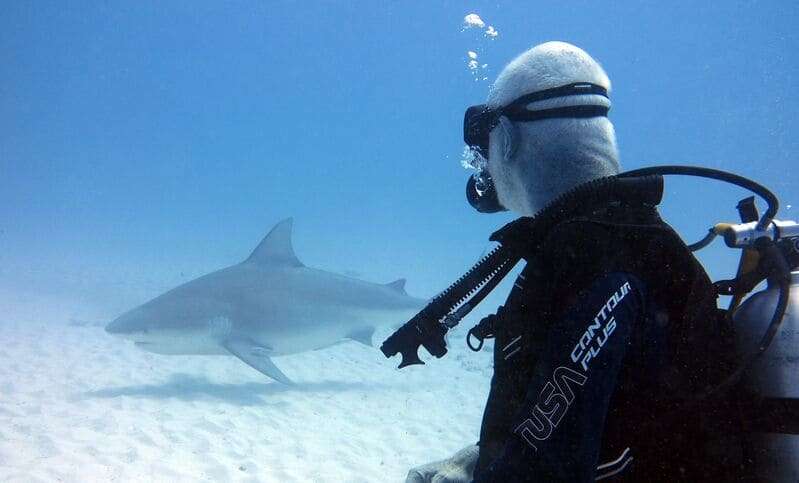
You’re scrolling through Instagram or reading a travel blog about Playa del Carmen, and you see it: a photo of a scuba diver hovering completely still on the sandy ocean floor while a massive, powerful bull shark glides just a few meters away.
Your heart rate spikes. Part of you thinks, “Wow, that looks like the ultimate adrenaline rush. I want to experience that.”
But another part of you—or perhaps your spouse, partner, or mom who is looking over your shoulder—instantly panics:
“Are you crazy? Bull sharks are man-eaters! Didn’t you watch Jaws? Is diving with bull sharks actually safe, or is it an accident waiting to happen?”
It is completely normal to feel apprehensive. The media, movies, and sensationalized news headlines have spent decades painting bull sharks as mindless, aggressive villains.
But as a professional diver, let me tell you a secret: Hollywood lied to you.
When done correctly with a certified professional, diving with bull sharks in Playa del Carmen is not only incredibly safe, but it is also one of the most strictly regulated, respectful, and educational wildlife encounters on the planet.
Let’s strip away the Hollywood myths and look at the real science, the local safety protocols, and what actually happens when you drop down into the territory of these magnificent apex predators.
The Reality Check: Who Are the Playa del Carmen Bull Sharks?
To understand why this dive is safe, you first need to understand why the sharks are here in the first place.
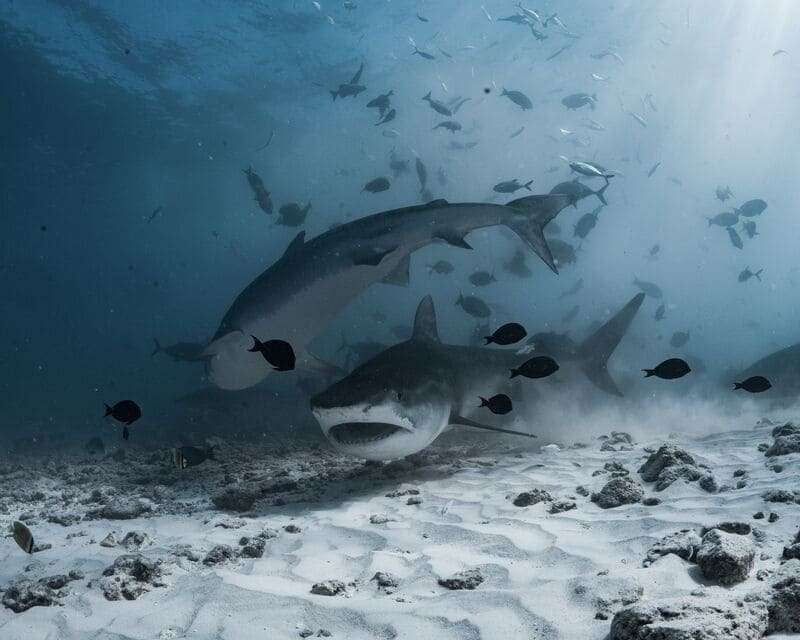
Every year, between November and March, a specific group of bull sharks arrives just a few hundred meters off the coast of Playa del Carmen. They aren’t roaming the waters looking for unsuspecting tourists on the beach.
1. They Are Almost Exclusively Pregnant Females
The sharks that visit Playa del Carmen are large, mature females, and nearly all of them are pregnant. They travel to the shallow, nutrient-rich waters of the Riviera Maya because the water temperature is ideal, and the nearby freshwater lagoons and mangroves offer the perfect, protected environment for them to eventually give birth.
2. They Are Calm and Conserving Energy
When animals are heavily pregnant, they aren’t looking to fight, chase down complex prey, or exert unnecessary energy. They are inherently more docile, cautious, and slow-moving. They spend their days cruising smoothly over the deep sandy plateaus of Playa del Carmen, completely indifferent to the strange, bubble-blowing humans watching them from the sand.
The Quick Safety Overview: Myth vs. Fact
If you or your loved one is still on the fence, let’s look at the hard facts of guided shark diving in the Riviera Maya:
| The Hollywood Myth | The Real Marine Fact |
| Myth: Bull sharks will attack anything that moves. | Fact: Sharks are highly visual predators. They know exactly what fish look like, and they know humans are not food. |
| Myth: It’s a chaotic free-for-all under the water. | Fact: Every shark dive follows strict, militaristic safety protocols mandated by local environmental authorities. |
| Myth: Accidents happen all the time on these tours. | Fact: There is a 0% accident rate for guided, stationary recreational bull shark dives in Playa del Carmen history. |
| Myth: You need to be a technical survival expert. | Fact: You just need an Advanced Open Water certification (or equivalent), good buoyancy, and a calm mindset. |
The Strict Safety Protocols: How We Keep You 100% Safe
We don’t just jump off a boat and hope for the best. The local diving community in Playa del Carmen, alongside marine biologists and the Mexican environmental authorities (CONANP), has developed a highly sophisticated set of rules for these encounters.
When you dive with an operator like Pasku Dive, your safety is built into every single step of the itinerary.
1. The Stationary “Wall” Setup
We do not swim around chasing the sharks. That would startle them and cause chaotic movement. Instead, we descend directly to a deep sandy plateau (around 24 to 28 meters / 80 to 90 feet).
Once at the bottom, all divers kneel or lie flat on the sand in a single, controlled line. We become a static part of the landscape. The sharks simply swim past this “wall” of divers out of sheer curiosity, keeping a respectful distance while moving in their natural circular patterns.
2. The Strict “Dark Suit” Code
Sharks are attracted to high contrast and bright, flashing reflections. To ensure we do not look like a shiny school of fish, all divers must wear full, dark wetsuits (black or dark blue), dark fins, and dark masks. No bright yellow neon snorkels, no flashing metallic jewelry, and no white gloves. By blending into the deep blue background, we remain completely uninteresting to the sharks.
3. Absolute No-Touch Policy
This is a passive observation dive. No one is allowed to reach out, touch, pet, or swim toward a shark. Keeping our hands tucked into our chests ensures that the sharks maintain their natural boundaries and view us as non-threatening objects.
4. Expert Marshalling and Extra Air
On every single shark dive, your primary guide is backed up by secondary safety divers. We carry extra independent air supply systems (pony bottles or drop lines) so that nobody ever has to worry about running low on gas while deep. Your guide’s eyes are continuously scanning the group and the perimeter, maintaining total control of the environment from descent to ascent.
Why the Safety Record is Perfect
Think about this logically: thousands of divers participate in the Playa del Carmen bull shark season every single winter. If it were inherently dangerous, insurance companies, international scuba agencies (PADI, SSI), and the Mexican government would have shut it down years ago.
Instead, the industry is thriving because the accident rate among guided recreational tours is zero.
Sharks are highly evolved animals with specialized sensory systems. They possess an organ called the Ampullae of Lorenzini, which allows them to detect electromagnetic fields. They can feel your heartbeat, they can see your silhouette, and they know with absolute certainty that you are a mammalian diver, not a injured fish or a natural food source. Accidents in the wild almost exclusively happen due to murky water, spearfishing, or mistaken identity at the surface. In the crystal-clear water of a guided deep dive, mistaken identity is practically impossible.
A Note for the Concerned Partner: “Should I Let Them Do It?”
If you are reading this because your husband, wife, or partner wants to book a shark dive and you are terrified for their life, we hear you. Your concern comes from a place of love.
But consider this: your partner will be coming back from this dive changed for the better. Witnessing a 3-meter apex predator glide peacefully through the deep blue ocean is an emotional, awe-inspiring experience that replaces fear with profound respect for nature.
They won’t be in danger. They will be sitting quietly on the sand, surrounded by highly trained rescue professionals, watching a beautiful natural migratory phenomenon. It is arguably safer than navigating the highway traffic on the way to the airport!
Experience the Thrill Safely with Pasku Dive
The secret to a truly unforgettable shark dive doesn’t lie in the sharks—it lies in your instructor. If you go with a massive, corporate “cattle boat” operator, you will be dropped into the water with 15 strangers, some of whom might be panicking, over-breathing, or kicking up sand, which ruins the experience and compromises safety.
At Pasku Dive, we do things differently. I personally manage our shark excursions with an uncompromising focus on safety, responsibility, and education:
Ultra-Small Groups: We keep our groups highly exclusive so I can monitor every diver’s comfort and air consumption personally.
Comprehensive Briefing: Before we even touch the water, we sit down for an in-depth briefing covering shark anatomy, body language, exact descent procedures, and safety protocols.
Personalized Pace: If you feel nervous, we don’t rush you. We take the descent slow, equalize comfortably, and make sure your mind is calm before we reach the viewing area.
Diving with bull sharks is a bucket-list privilege. Let’s do it in a way that respects the ocean, honors the animals, and guarantees you step back onto the boat with a massive smile and complete peace of mind.
[Message Pasku Dive on WhatsApp today to check availability for the upcoming winter season.] Space is strictly limited due to local eco-regulations, so let’s lock in your private or small-group briefing today!