A personalized service isn’t a luxury whim. It’s the best way to explore the most spectacular underground rivers on the planet without rush or crowds. If you’re planning your trip and want to know exactly how a private day in the cenotes is structured, what to expect and what to check before you book, this article walks you through the whole day.
Why choose private diving to explore the cenotes
When you travel a long way to dive, the quality of the experience comes first. The underground world of the Maya isn’t a conventional open-water setting. These are delicate limestone caverns, confined spaces where light creates natural cathedrals and where the fine sediment on the floor demands excellent buoyancy and technique. A large group excursion often means stressful early mornings, queues at the entrance and reduced visibility after a long line of divers has passed through.
| Large group tour (8–10 divers) | Private diving (your pace) |
|---|---|
| Fixed schedules | Pick-up times that suit you |
| Paced by the slowest diver | One-on-one or your own private group |
| Standard routes | Cenotes chosen for your level and interests |
| Waiting and crowds | Time for photos, no rush |
Private diving changes all of that, with very clear advantages:
- Attention tailored to your level: whether you hold an Open Water certification and are looking for your first cavern experience, or you’re a Full Cave diver with hundreds of dives behind you, your guide adapts the dive profile to your skills.
- Smart timing: the biggest advantage of not depending on other clients is arriving before the tour buses. Being the first to enter a cenote means finding crystal-clear water that nobody has disturbed yet.
- More bottom time: in large groups, the dive ends when the first person reaches their air reserve. On a private trip, if your air consumption is good, you can make the most of your bottom time without cutting the fun short.
A typical private cenote diving day, hour by hour
One of the most common questions is how the day is organized. Flexibility is the whole point of private diving, but a reference schedule helps you plan the rest of your holiday.
| Time | What happens |
|---|---|
| 7:30 – 8:00 | Pick-up at your hotel or apartment |
| 8:00 – 8:45 | Drive to the cenote area and safety briefing |
| 9:00 – 10:00 | First dive, with the best morning light beams |
| 10:00 – 11:15 | Surface interval, snacks and tank change |
| 11:30 – 12:30 | Second dive in a different cenote |
| 12:45 – 14:00 | Lunch break |
| 14:30 – 15:30 | Relaxed return to your accommodation |
7:30 – Pick-up at your accommodation
The day starts at the door of your hotel or villa, whether you’re staying in Playa del Carmen, Tulum or Puerto Morelos. Unlike shared buses that stop at one resort after another, a private pick-up only collects you and your companions. You gain up to an extra hour of sleep, something you’ll appreciate if you’re still adjusting to the time difference after a long flight.
8:30 – Arrival and personal briefing
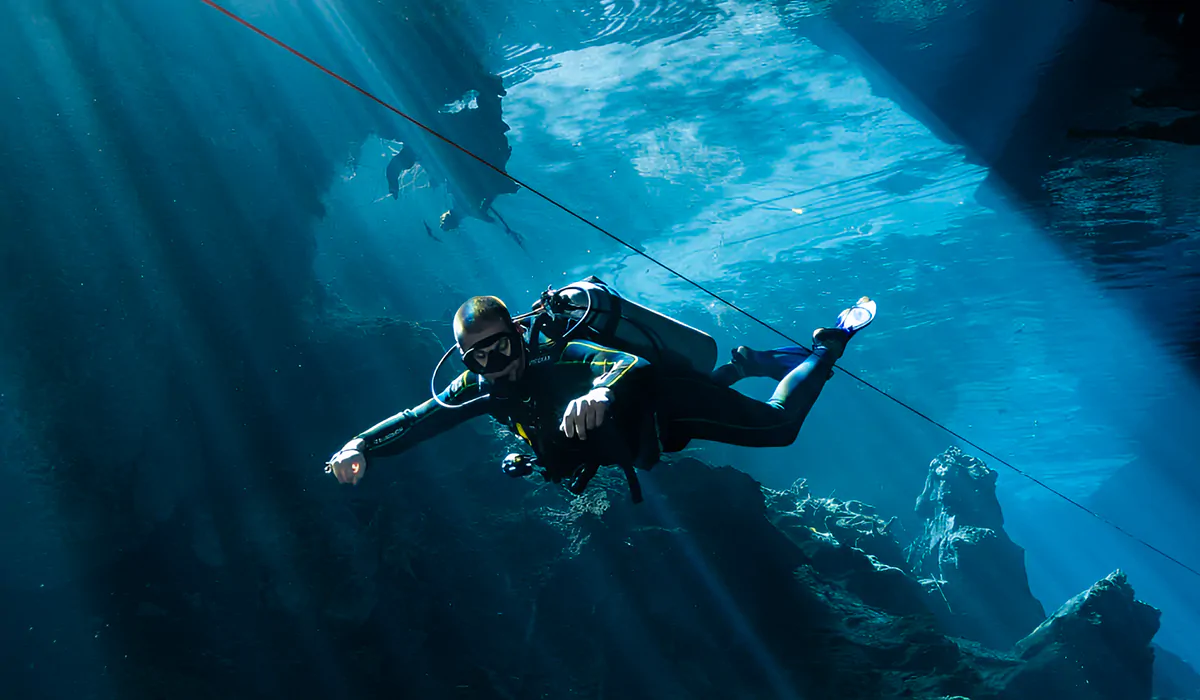
When you arrive at the first cenote, your guide takes care of the entrance while you get ready for the technical briefing. In private diving, this briefing is never a rushed five-minute formality. Your instructor goes through the cavern layout with a map, shows where the main guideline runs, explains the safety rules for overhead environments, reviews the light signals and helps you polish your frog kick so you don’t stir up the sediment. Map, air management, guideline, light signals: every step is covered before you get in the water.
9:00 – First dive: the morning light show
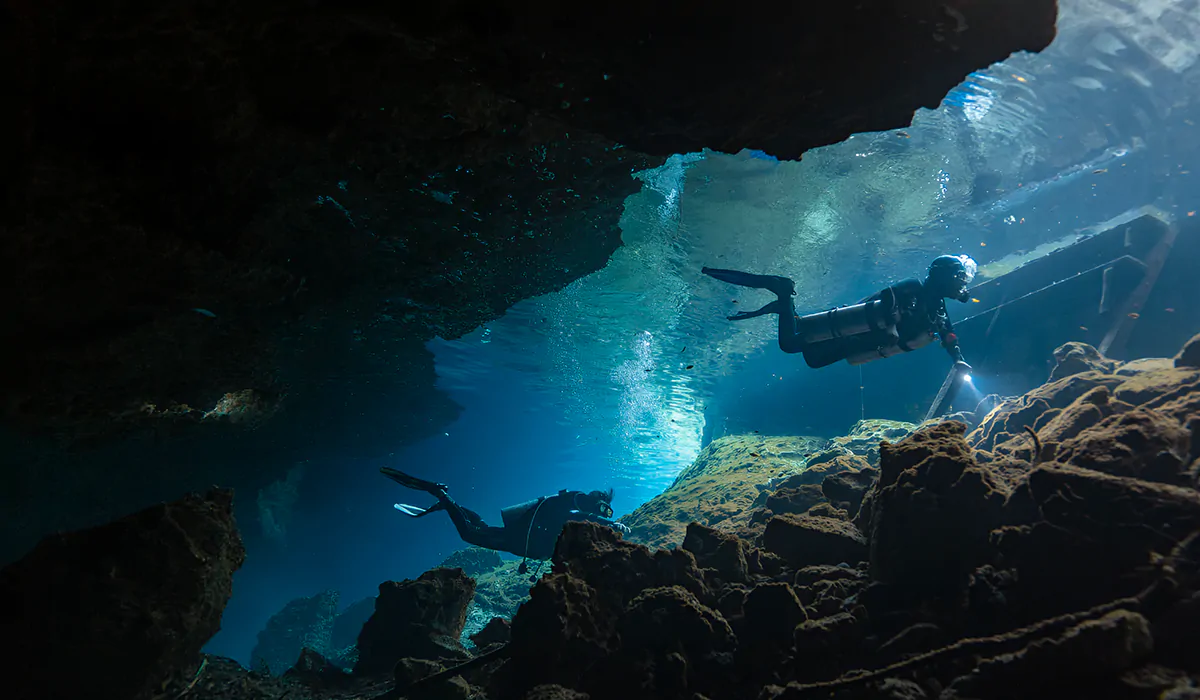
Diving early in the morning has a huge visual reward. With no other groups in the water, the sunlight cuts cleanly through the jungle canopy and creates intense turquoise beams that look like lasers slicing through the shadows. It’s the perfect time for deep cenotes or those with large openings, such as El Pit or Cenote Maravilla.
11:30 – Second dive: a different underground world
After a relaxing surface interval with a coffee or some fresh fruit, you move on to the second site. A tailored itinerary usually combines two complementary dives. If the first one was about depth and light, the second focuses on the rock architecture: thousands of stalactites, stalagmites and stone columns at sites like Dos Ojos or Chikin Ha.
What to check before you book
When you book a private cenote day, check exactly what is covered in the price so there are no surprises on the day. A good service takes care of the logistics so you can focus on enjoying the weightlessness. These are the points worth confirming with your dive center:
| Item | What to confirm |
|---|---|
| Guide | A certified cavern guide or Full Cave instructor, just for you |
| Transport | Private round trip from your accommodation |
| Equipment | Regulators, primary and backup lights, wetsuit |
| Tanks and fees | Tanks, weights and cenote entrance fees |
| Food and drinks | Water, snacks and lunch |
A certified cavern guide just for you
Divers around the world are used to open-water standards from agencies such as PADI, SSI, SDI/TDI or other recognized agencies. In the cenotes of Mexico, however, the professional leading the dive should not simply be an open-water Divemaster, but a certified cavern guide or Full Cave instructor. This qualification means they master navigation in the dark zone, emergency management under an overhead and respect for the geological and archaeological heritage of each site.
Comfortable private transport
Forget squeezing into a seat with dive bags between your legs. A private vehicle has room for your equipment, wetsuits, BCDs, lights and tanks without sacrificing comfort. And during the drive along the coastal highway, you can chat with your guide about Maya culture or the local food.
Equipment for cavern diving
Diving in freshwater caverns has different requirements from open-water ocean diving:
- Powerful lights: every diver carries a strong primary light plus a backup light, to look into dark corners and communicate with light signals.
- Proper thermal protection: the water in the cenotes stays at around 24–25°C (75–77°F) all year. It isn’t cold, but a full 3 mm to 5 mm wetsuit is essential to avoid slowly losing body heat on dives that often last more than 50 minutes.
- Adjusted weighting: you float less in fresh water than in the sea, so you’ll need less weight on your belt or in your pockets. Your guide fine-tunes this with you before you get in.
Entrance fees and local food
Many of the most beautiful cenotes are on ejido land, owned by local Maya communities that charge an entrance fee to maintain the sites and protect the jungle. A well-organized private diving day takes care of these fees in advance, so you don’t need to hunt for cash on the spot. It’s also a great opportunity to try real Yucatecan food after your dives: cochinita pibil, poc chuc or salbutes.
Recommended cenotes for your diving level
Not every diver is looking for the same sensations. A custom trip lets you choose sites that match your experience, your certifications and your personal tastes.
For recreational divers (Open Water or equivalent)
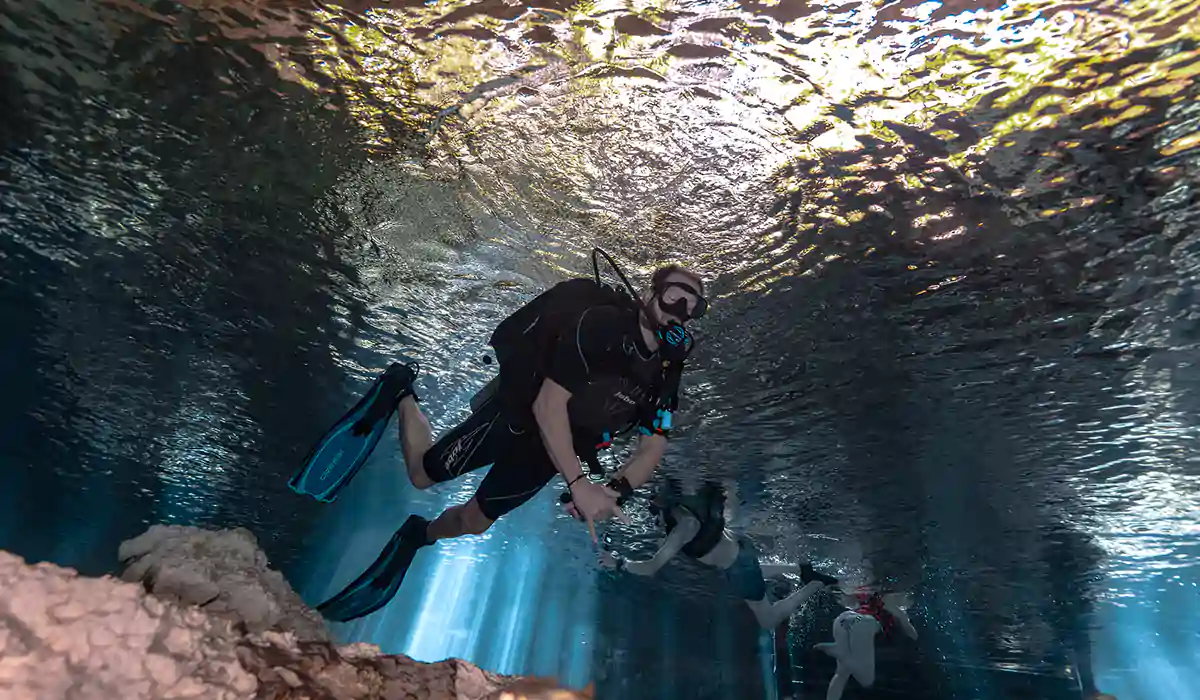
If this is your first time in an enclosed freshwater environment, the goal is to enjoy the natural light and build confidence in calm water with no currents or waves.
- Cenote Chac Mool: famous for its stunning sunbeams and for one of the clearest haloclines (the visible border between fresh and salt water) that recreational divers can reach.
- Cenote Dos Ojos: two different circuits, the Barbie Line and the Bat Cave Line, full of limestone columns, marine fossils in the walls and large rooms with frequent openings to the surface.
- Cenote Chikin Ha: a calm, bright cenote with open areas and gentle cavern sections, ideal for a first cenote day.
For advanced divers and underwater photographers
If you hold an Advanced Diver certification or a deep diving specialty, have excellent buoyancy control or love wide-angle photography, you’ll want more dramatic, shadowy landscapes.
- El Pit: a vertical sinkhole famous for its central light beam, its layer of hydrogen sulfide floating around 30 meters (about 100 feet) and the submerged trees that seem to hang in the cloud. It’s a deep dive, reserved for experienced divers.
- Cenote Zapote (Hell’s Bells): a unique site to see the famous bell-shaped formations, which formed underwater and are found almost nowhere else in the world.
- Cenote Tajma Ha: haloclines, light beams and varied cavern sections, a favorite for photographers.
Practical tips for international divers
Wherever you’re flying from, a few simple preparations make a big difference to your trip:
- Bring your certification card: physical or digital, from PADI, SSI, SDI/TDI or other recognized agencies.
- Check your dive insurance: make sure your dive insurance (DAN, Divers Alert Network, or another dive insurer) covers cavern and overhead diving and medical care abroad. If you don’t have one, you can buy short-term dive insurance for your trip before you leave.
- Choose eco-friendly sun protection: chemical sunscreens and insect repellents are strictly forbidden in the cenotes, because the oils float on the surface and harm these fragile ecosystems. The best option is a long-sleeved UPF 50+ rash guard for your surface intervals.
- Respect the no-fly time: when you plan the last days of your trip, leave at least 24 hours between your last dive and your flight home, to avoid decompression risks from the cabin pressure changes.
Design your unforgettable day under the Maya jungle
Diving the underground rivers is one of the most impressive adventures on Earth. Floating in total stillness, gliding over crystal-clear haloclines and admiring millions of years of geological history is a privilege best enjoyed without rush, without crowds and with maximum safety.
Choosing private diving means every detail of your day, from your morning pick-up to your last safety stop, is planned around your comfort and your preferences. It’s the difference between another routine tourist excursion and a memory that lasts a lifetime.
If you’re planning your next trip to the Mexican Caribbean and want to explore the hidden gems of the Yucatán Peninsula with certified guides, we’re ready to build your custom itinerary. Discover our cenote dives, book your private cenote daybook your private cenote day or contact us with any question. See you in the cenotes!