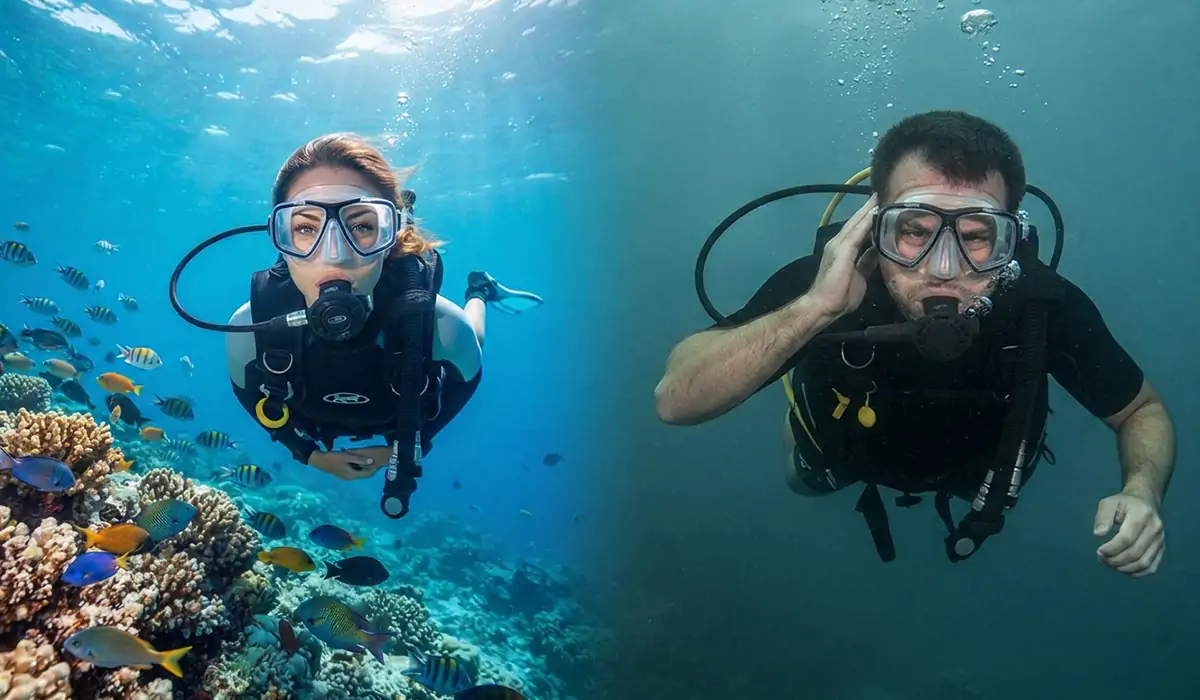
It’s completely normal to have questions about your health or your eyesight before diving. The good news is that poor eyesight and some ear problems don’t have to stop you from enjoying the ocean, as long as you know the solutions, the medical limits and the precautions to take before you go under. In this guide, we answer both questions in detail so you can get in the water with complete peace of mind and maximum safety.
Diving with contact lenses or prescription lenses
If you need glasses or contact lenses in daily life, the idea of diving without seeing the marine life, your pressure gauge or your dive computer clearly is frustrating. Fortunately, there are good solutions to see perfectly underwater.
Can you wear contact lenses while diving?
The short answer is yes, you can dive with contact lenses, as long as you take a few basic precautions. Thousands of divers around the world wear them without any problems. But you should keep in mind what could happen if your mask floods by accident:
- Risk of losing them: if water enters your mask and you open your eyes by reflex, a lens can move or float away.
- Risk of infection or irritation: sea water and pool water contain bacteria and microorganisms that can get trapped between the lens and your eye.
- Dry eyes: salt water, or the dry air from the regulator, can dry your eyes a little.
Daily disposable lenses or reusable lenses?
If you decide to dive with contact lenses, optometrists and dive professionals agree: use daily disposable soft lenses.
- Daily disposables: the best option. If they get salt water in them or become dirty, you just throw them away after the dive and put in a clean pair.
- Rigid or gas-permeable lenses: not recommended for diving. With the pressure changes, small gas bubbles can get trapped between the lens and the eye, causing blurry vision or discomfort during the ascent.
Practical tips for diving with contact lenses
- Always tell your guide or instructor: the professional diving with you needs to know you wear contact lenses, especially for the mask-clearing exercises.
- Close your eyes if your mask floods: if water gets into your mask, keep your eyes gently closed while you clear it by blowing air out through your nose.
- Bring saline solution or eye drops: after the dive, rinse your eyes with saline solution before taking out or changing your lenses.
The best alternative: a prescription dive mask
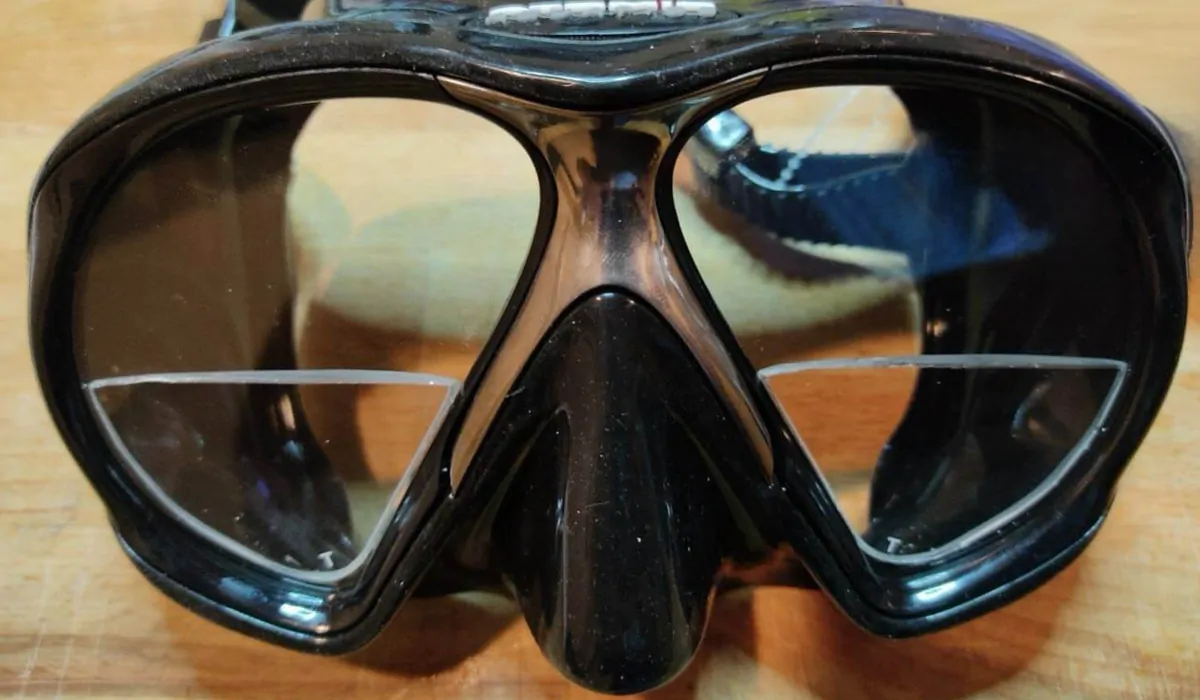
If you dive often or prefer not to risk your contact lenses underwater, the best solution is a prescription dive mask. Most major brands offer interchangeable corrective lenses for nearsightedness, farsightedness and even reading vision. It’s a comfortable, durable and completely safe option that removes the problem at its root.
How pressure affects your ears when you dive
Going underwater means your body goes through gradual pressure changes as you descend. Your eyesight is easy to correct, but ear problems require a basic understanding of how your ears work and of a few safety rules.
Your ear has three parts: the outer ear (the ear canal, which fills with water when you dive), the middle ear (a small air space behind the eardrum) and the inner ear (which controls hearing and balance). The middle ear is connected to the back of your throat by the Eustachian tube.
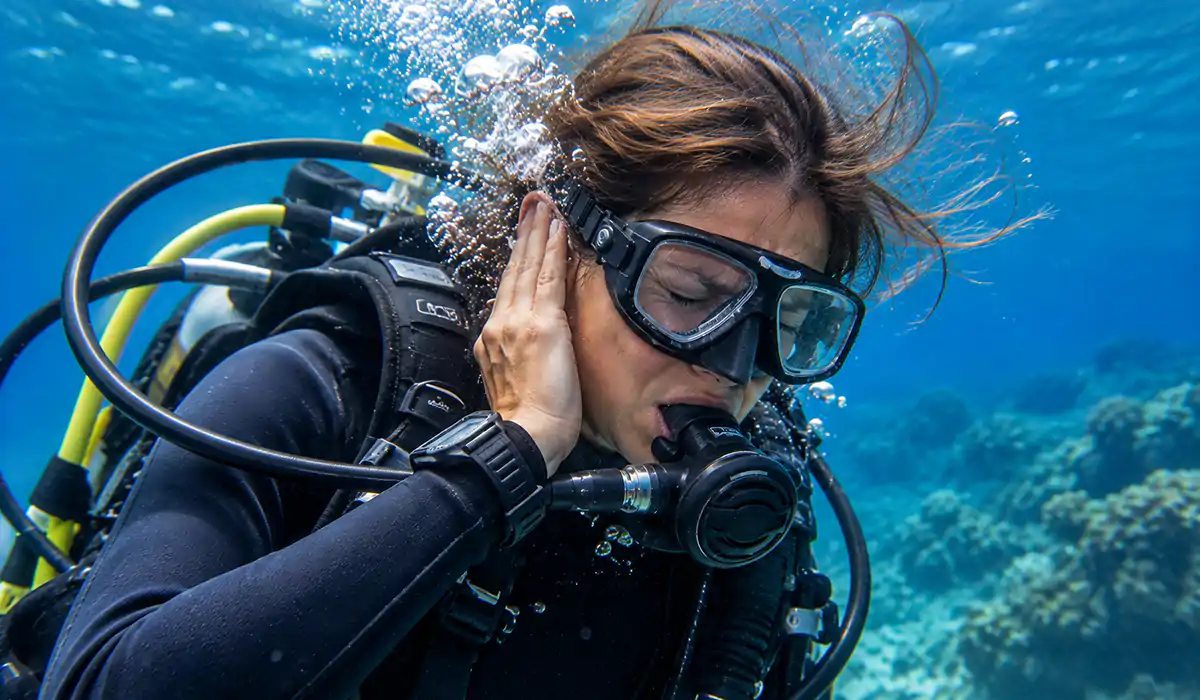
As you descend, the water pressure on your eardrum increases. If you don’t equalize properly, by sending air into the middle ear through the Eustachian tube, you feel pain, and you can suffer an ear barotrauma, the most common injury in diving.
How to prevent ear problems on your dives
Having sensitive ears or getting congested easily doesn’t necessarily mean giving up diving, but it does mean being very careful with prevention and mastering the equalization techniques.
Start equalizing at the surface
The most common mistake among beginners is waiting until it hurts to equalize. The golden rule is to equalize early and often:
- Start equalizing at the surface, just before putting your head underwater.
- Equalize gently every half meter (about every 2 feet) during the first few meters of the descent, where the pressure change is greatest.
- Never force it: if you feel pain, stop your descent, go up a little until the discomfort disappears, and try again calmly.
Equalization techniques
The best-known technique is the Valsalva (pinching your nose and gently blowing through it with your mouth closed), but it isn’t always the best for everyone. There are gentler alternatives:
- Frenzel technique: pinch your nose and push the back of your tongue up against your soft palate. It’s a precise movement and gentler than the Valsalva.
- Toynbee maneuver: pinch your nose and swallow at the same time. When you swallow, your muscles open the Eustachian tube and let the air in.
- Voluntary opening (BTV or Roydhouse): tense the muscles of the soft palate and throat, as if yawning with your mouth closed, to open the tubes without using your hands.
| Technique | How to do it | Advantages |
|---|---|---|
| Valsalva | Pinch your nose and blow gently | Very easy to learn |
| Frenzel | Push the back of your tongue up | Fast, no effort from the chest |
| Toynbee | Pinch your nose and swallow | Natural and gentle |
| Voluntary opening (BTV / Roydhouse) | Yawn with your mouth closed | Hands-free and pressure-free |
When ear problems mean you shouldn’t dive
Some temporary or long-term conditions mean you should not dive until you’ve been checked by a doctor trained in diving medicine or an ENT (ear, nose and throat specialist).
Temporary reasons not to dive
These conditions block the free flow of air through your airways and Eustachian tubes:
- Colds, flu or allergies: mucus and inflammation block the tubes. Diving while congested can cause a “reverse block”: the air trapped in your ears can’t escape during the ascent, which causes intense pain.
- Ear infections (outer or middle ear): water in an inflamed ear canal, or a middle ear that isn’t working properly, will make the infection much worse.
- Nasal decongestant sprays: never dive using decongestant sprays. If the effect wears off during the dive, the congestion comes back and can stop you from equalizing on the way up.
Serious conditions
In these situations, you should not dive unless a doctor trained in diving medicine gives you clear written approval:
- A previous or unhealed perforated eardrum: cold water could enter the middle ear directly and cause violent vertigo and disorientation.
- Previous ear surgery: for example, surgery on the small bones of the middle ear (such as a stapedectomy).
- Ménière’s disease or a history of chronic vertigo: losing your balance underwater is extremely dangerous.
Medical questionnaire and ear care
Before any try dive or course, all recognized dive centers ask you to fill in the standard diver medical questionnaire. It works the same way almost everywhere in the world:
- If you answer “no” to every question, you can usually dive directly.
- If you answer “yes” to a question, for example about ear problems, sinusitis or allergies, you’ll need a doctor’s certificate saying you’re fit to dive before you get in the water. Bring it with you on your trip so you don’t lose a day.
A few simple habits also protect your ears:
- Rinse with fresh water: after your dives, rinse your ears with clean fresh water to remove salt and sand.
- Dry gently: avoid cotton swabs, which can cause small injuries in the ear canal and trap bacteria. If you’re prone to ear infections after diving, ask your doctor about drying drops to use after your dives.
Our checklist for your ears and your eyes
Diving is completely compatible with vision correction and with taking good care of your ears. To make your experience smooth, remember this quick checklist:
- Choose daily soft lenses or a prescription mask: put hygiene and comfort first before jumping off the boat.
- Never dive with a blocked nose: if you have a cold or trouble breathing through your nose, postpone your dive.
- Equalize gently and take your time: go down at the speed your ears allow, and never rush to keep up with the group.
- Tell your guide about any discomfort: professional instructors are trained to adapt the descent to your needs.
- Ask a professional: if you have any doubts about your ears, see an ENT specialist trained in diving medicine.
Dive with peace of mind
Don’t let questions about your eyes or ears keep you from discovering the underwater world. Diving safely, comfortably and at your own pace is the key to getting past any small hurdle and turning every dive into an unforgettable memory.
If you want to take your first steps with a Discover Scuba experience, get certified with an Open Water course or keep training with professionals who adapt to your pace and needs, we’ll be happy to advise you at Pasku Dive. Contact us with your questions, or book your next dive today!