
For many Spanish travelers, the word “vacation” used to be synonymous with the Balearic Islands or the rugged coves of the Costa Brava. We are a nation that loves the sea, but once you have experienced the crystal-clear waters of the Mexican Caribbean, your perspective on aquatic adventure changes forever. Among all the attractions in the Riviera Maya, one stands out as a true geographical anomaly: the cenotes. When planning your trip, you will inevitably face a dilemma: should you stick to Snorkeling in the Cenotes or is it time to strap on a tank and dive deep?
The Yucatan Peninsula is home to the world’s most extensive network of underground rivers and flooded caves. For the ancient Mayans, these were sacred portals to the underworld (Xibalbá). Today, they represent the ultimate playground for water enthusiasts. Whether you are floating on the surface or hovering in the depths, the experience is almost spiritual. In this guide, we will break down the differences, the pros and cons, and why—for many—taking the plunge into scuba diving is the best decision they ever made.
What Exactly are Cenotes?
Before we compare the activities, we need to understand the stage. A cenote is a natural pit, or sinkhole, resulting from the collapse of limestone bedrock that exposes groundwater underneath.
A Geological Marvel
Unlike the saltwater diving we are used to in places like Cabo de Palos or El Hierro, cenotes are predominantly freshwater. This means:
- Zero salinity: You don’t get that “sticky” feeling after the session.
- Infinite visibility: Because there is no salt or plankton, the water is as clear as air.
- Haloclines: In many cenotes, freshwater sits on top of denser saltwater, creating a visual “blurry” effect that looks like shimmering jelly.
Snorkeling in the Cenotes: The Gateway Experience
For families, casual swimmers, or those who aren’t quite ready for a full scuba course, Snorkeling in the Cenotes is a world-class experience. It is accessible, affordable, and requires zero previous training.
Why You’ll Love the Surface View
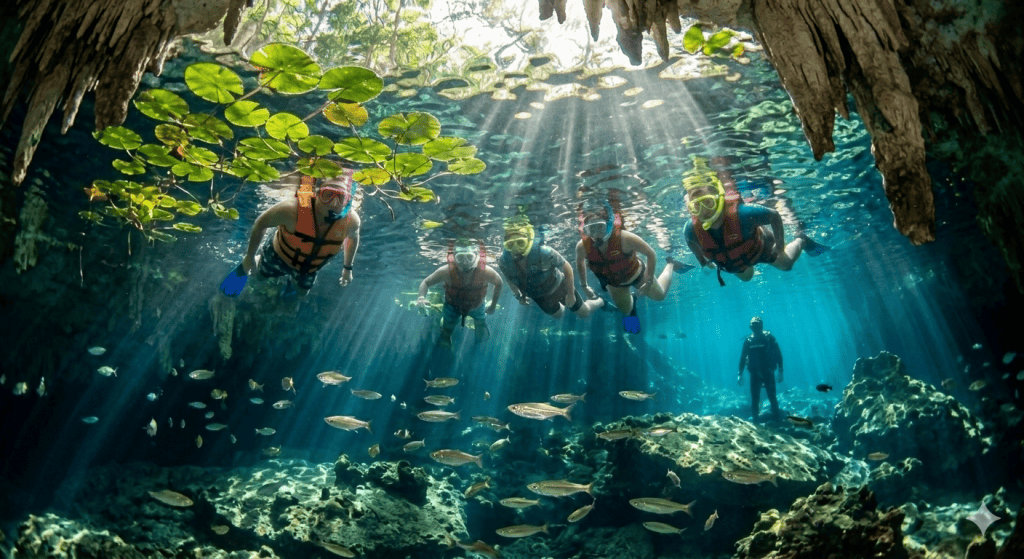
Many people underestimate what you can see from above. When you are Snorkeling in the Cenotes, you get a unique perspective on the light shows. Since most cenotes are surrounded by lush jungle, the sun’s rays penetrate through the trees and the water’s surface, creating “lasers” of light that dance on the limestone floor.
- Topography: You can admire the massive stalactites hanging from the ceiling and the lily pads that often decorate the open-air cenotes.
- Ease of Movement: You don’t have to worry about buoyancy or nitrogen limits. You just float and breathe.
- Perfect for Everyone: In Spain, we often travel in large “cuadrillas” (groups of friends) or multi-generational families. Snorkeling is the one activity that the kids, the parents, and even the grandparents can enjoy together.
Limitations of Snorkeling
While beautiful, Snorkeling in the Cenotes only gives you a “preview” of the underworld. You are confined to the surface, looking down at a world that is meant to be explored in three dimensions. You miss out on the silent tunnels, the intricate fossils embedded in the deep walls, and the sensation of total weightlessness that only scuba diving provides.
Why You Should Consider Diving: The “Plunge” Factor
If snorkeling is like looking through a window, diving is like walking through the door. While Snorkeling in the Cenotes is fantastic, scuba diving in these caverns is a life-altering experience that many Spanish divers describe as “flying in another dimension.”
The Magic of the Cavern
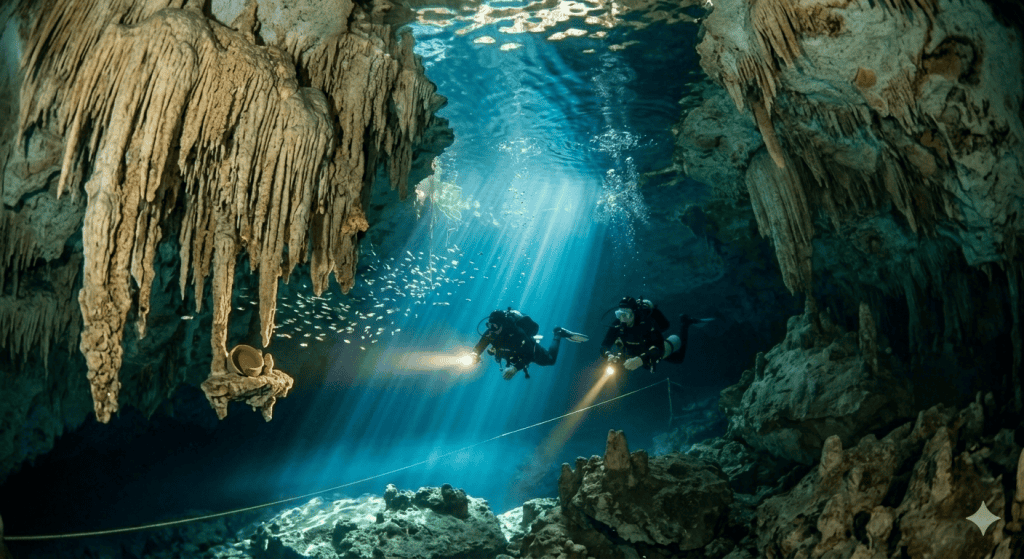
When you dive, you enter the cavern zone. This is the area where natural light is still visible. You aren’t “cave diving” (which requires years of technical training); you are simply exploring the massive rooms and galleries that connect the sinkholes.
1. The Light Show from Below
From the surface, light rays are pretty. From 10 meters deep, they are hypnotic. Seeing the “curtains of light” shimmer as you hover perfectly still is a sight that no snorkel mask can fully capture.
2. The Halocline Experience
As mentioned before, the halocline is a phenomenon where salt and freshwater meet. Divers can actually swim through it. It feels like passing through a mirror or a layer of oil. It is a sensory experience that is impossible to achieve while Snorkeling in the Cenotes.
3. Total Silence and Weightlessness
In the Mediterranean, we are used to the sound of boat engines and the surge of the waves. In a cenote, there is absolute silence. You can hear your own heartbeat and the slow rhythm of your bubbles. It is the closest thing to being in outer space.
Comparing the Two: A Practical Guide
| Feature | Snorkeling in the Cenotes | Scuba Diving in Cenotes |
| Effort Level | Low | Moderate (requires certification) |
| Duration | Flexible | Approx. 45-50 mins per tank |
| Visibility | Excellent | Infinite |
| Cost | Budget-friendly | Mid-range to high |
| Equipment | Mask, snorkel, fins, life vest | Full scuba gear + guide |
Safety and Environmental Considerations
Whether you are Snorkeling in the Cenotes or diving, the ecosystem is incredibly fragile. The limestone formations (stalactites and stalagmites) took millions of years to grow.
- No Sunscreen: Just like in our Marine Reserves in Spain, chemicals from sunscreens kill the delicate flora and fauna. Most cenotes strictly forbid any type of cream unless it is 100% biodegradable (though “no cream” is the best policy).
- No Touching: The oils from human skin can stop the growth of mineral formations.
- Buoyancy is Key: If you decide to dive, you must have good control of your fins. Kicking up silt can ruin the visibility for everyone and damage the cave.
Choosing the Right Cenote for Your Level
Not all cenotes are created equal. Some are perfect for Snorkeling in the Cenotes, while others are designed for advanced divers.
Best for Snorkelers:
- Casa Cenote: This is an open-air mangroove cenote. It feels like a crystal-clear river winding through the jungle. You can see blue crabs and even a friendly crocodile named “Panchito” (don’t worry, he’s used to tourists!).
- Garden of Eden (Ponderosa): Large, open, and full of fish. It’s like a natural swimming pool.
Best for Divers:
- The Pit: A deep, dramatic sinkhole that goes down to 40 meters. It features a hydrogen sulfide cloud that looks like a ghost forest.
- Dos Ojos: Famous for its “Barbie Line” and “Bat Cave,” it offers incredible limestone formations and easy cavern routes.
Planning Your Adventure from Spain
If you are coming from Madrid, Barcelona, or any part of the Peninsula, you likely have questions about logistics.
When to Go
The “cenote season” is year-round. Unlike the sea, which can get rough with the “Levante” or “Tramontana” winds, cenotes are protected from the weather. The water temperature is a constant 24-25°C. For a Spaniard used to the 18°C waters of the Med in June, this is a dream. However, you will still want a 5mm wetsuit for diving, as you lose body heat faster in freshwater.
Experience and Certification
To dive in most cenotes, you need at least an Open Water certification. Some deeper cenotes require Advanced training. If you are currently just a snorkeler, don’t worry! You can take your PADI or SSI course right there in Playa del Carmen and do your first “real” dives in the cenotes.
Why Pasku Dive is Your Best Partner in the Riviera Maya
Whether your heart is set on Snorkeling in the Cenotes or you are ready to take the plunge into scuba diving, who you go with matters. For Spanish travelers, there is a certain “comfort factor” in finding a team that speaks your language and understands your expectations for safety and fun.
I highly recommend Pasku Dive for your Mexican adventure.
Why Choose Them?
- Spanish Excellence: They offer the professionalism and safety standards we are used to in European diving, but with the warm, local hospitality of the Caribbean.
- Small Groups: They avoid the “mass tourism” crowds. This is especially important in cenotes, where a large group can quickly silt up the water.
- Expert Guides: Their guides are cenote specialists. They know the history, the geology, and the best “secret” spots that big tour operators ignore.
- Full Logistics: They can help you organize everything, from gear rental to transportation from your hotel.
Visit their website at https://paskudive.com/ to see their cenote packages and start planning your trip.
Don’t Just Float, Explore!
There is nothing wrong with Snorkeling in the Cenotes. It is a beautiful, relaxing, and visually stunning way to spend a day. But if you have even a spark of curiosity about what lies beneath the surface, I urge you to take the plunge. Diving in a cenote is one of the few things in life that actually lives up to the hype. It is quiet, it is magical, and it will give you stories to tell for the rest of your life back in Spain.
Imagine sitting at a “chiringuito” back home, showing your friends photos of you floating in a prehistoric cave with light beams piercing the water like a cathedral. That is the magic of the cenotes.
Are You Ready to Take the Plunge?
The jungle is calling, and the sacred waters are waiting. Whether you choose to snorkel or dive, the experience will stay with you forever.
Don’t wait! Contact the experts at Pasku Dive today and secure your spot in the most magical waters on Earth. Whether it’s your first time snorkeling or your hundredth dive, they will make sure it’s an experience you’ll never forget. ¡Nos vemos bajo el agua!