For many Spanish divers, the word “shark” used to be associated only with documentaries or the occasional (and very rare) sighting of a blue shark in the Mediterranean. We are accustomed to the calm waters of the Balearic Islands or the rocky walls of the Costa Brava, where the most “dangerous” thing you might encounter is a grumpy moray eel or a stinging jellyfish. However, there is a growing community of divers from Madrid, Barcelona, and Valencia seeking something that gets their adrenaline pumping. If you’re looking for the ultimate underwater thrill, bull shark diving in Mexico is the experience of a lifetime.
Every year, between November and March, the sandy bottoms off the coast of Playa del Carmen become the temporary home for dozens of pregnant female bull sharks (Carcharhinus leucas). This isn’t just a dive; it’s a masterclass in marine biology and a profound lesson in respect for one of the ocean’s most misunderstood predators. In this guide, we’ll break down everything you need to know—from technical requirements to emotional impact—to ensure your encounter is safe, ethical, and unforgettable.
Why is bull shark diving in Mexico so unique?
Unlike other shark dives around the world that may require long boat journeys or “hanging” sessions in deep blue water, bull shark diving in Mexico is surprisingly accessible. The dive sites are located just a few hundred meters from the shore of Playa del Carmen.
The seasonal migration
The reason these sharks appear is purely biological. They are attracted by freshwater runoff from the cenotes (the famous freshwater sinkholes of the Yucatán Peninsula) and by slightly cooler water temperatures during the winter months. Most of the sharks observed are large, powerful females. For a diver from Spain, who may be accustomed to the Mediterranean’s seasonal changes, seeing such a massive concentration of apex predators in such a small area is truly breathtaking.
Ideal conditions for observation
Visibility in the Mexican Caribbean during bull shark season is generally excellent, often exceeding 25 meters. Water temperature hovers around 26°C—a luxury for those of us who have endured the 14°C waters of the Atlantic or the thermoclines of the Mediterranean in May. This clarity allows for incredible photography and a sense of safety, as you can see the animals approaching from a distance.
Safety protocols for bull shark diving in Mexico
When we talk about bull shark diving in Mexico, safety is the absolute priority. Bull sharks are heavy-bodied, powerful animals. While naturally cautious, they are also apex predators. Therefore, the local diving community follows strict international protocols to ensure the interaction remains passive and safe for both humans and sharks.
1. Group formation and positioning
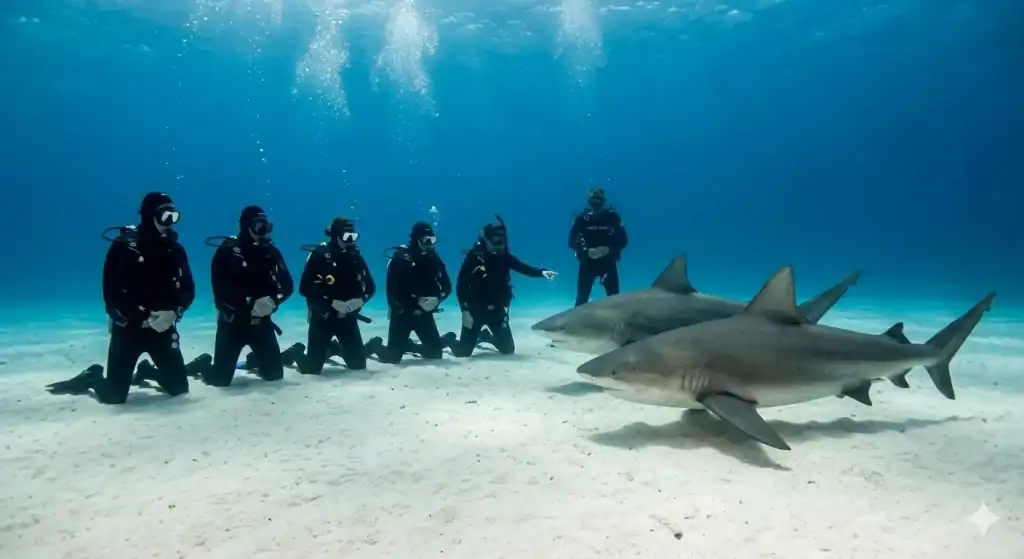
Typically, these dives are conducted in a “static” manner. Divers descend to a sandy bottom at about 24–25 meters and remain kneeling in a line. This keeps the group together and predictable. For those who have completed their Two-Star Diver (FEDAS) or Advanced Open Water (PADI/SSI) courses, this requires good buoyancy control during descent to reach the bottom smoothly without stirring up sediment.
2. Specialized equipment and dress code
- Full dark wetsuits: This is a crucial safety rule. Divers must wear full-length, dark-colored wetsuits (black or dark blue). Bright colors, neon fins, or shiny objects can mimic the flash of fish scales and confuse the sharks.
- No exposed skin: Many operators require gloves and hoods to ensure no pale skin (such as hands or necks) is visible. In Spain, we often dive without gloves in summer to feel the rocks, but here they are a safety tool.
- No splashing at the surface: Entry and exit from the water are performed quickly and quietly.
3. The role of the safety diver
In a professional bull shark diving in Mexico operation, there are always multiple guides. At least one “safety diver” positions themselves behind the group, scanning the perimeter to monitor shark behavior and ensure no diver drifts away from the line.
Environmental ethics: Feeding vs. observation
A common debate in the world of bull shark diving in Mexico is the use of bait (attraction) versus natural observation.
Observation dives
Many divers prefer a 100% natural encounter. In these dives, you sit quietly on the sand and wait. The sharks are naturally curious and will often cruise past the group at a respectful distance. It’s a peaceful, almost meditative experience that allows you to observe their natural swimming patterns.
Controlled feeding (attraction)
Some specially licensed operators conduct “feeding” dives. This is highly regulated by Mexican environmental authorities (CONANP). The goal is to keep the sharks in a specific area for educational purposes and to provide data for scientific research. Regardless of your personal stance, it’s vital to choose a provider that respects local laws and prioritizes animal welfare.
Training and experience required for the encounter
You can’t simply arrive in Mexico and dive with sharks on your first day. Due to the depth (approximately 25 m) and the potential for strong currents, bull shark diving in Mexico is reserved for experienced divers.
Certification levels
- Minimum level: You should hold an Advanced Open Water certification or its equivalent (such as FEDAS 2*).
- Experience: It’s highly recommended to have at least 25–30 logged dives. You need to feel comfortable with “negative entries” (dropping into the water and descending immediately without stopping at the surface) and managing your air consumption under the excitement of seeing a 3-meter shark.
- Nitrox: This is the secret weapon for shark diving. Using Enriched Air (Nitrox) allows you to stay at the bottom longer, giving you more time to enjoy the encounter while reducing the nitrogen load in your body. If you haven’t completed your Nitrox specialty in Spain yet, Playa del Carmen is the perfect place to do it.
Managing the “fear factor”: A professional perspective
It’s natural to feel a bit of “nerves” before your first shark dive. In Spain, we’re raised with a certain fear of the deep, fueled by movies and a lack of contact with large marine life. However, once you’re down there, that fear almost always transforms into awe.
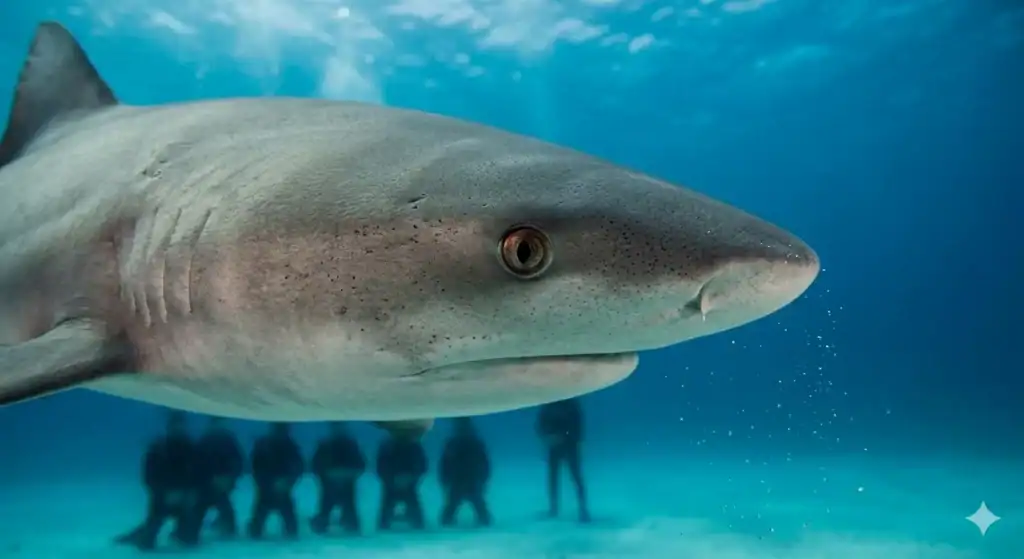
Bull sharks are not mindless man-eaters. They are curious, elegant, and highly aware of their surroundings. Watching them move through the water with effortless power is a humbling experience. It changes your perspective on ocean conservation forever. When you return to Spain and hear someone talking about “dangerous sharks” at the beach, you’ll be the one explaining that the ocean is their home, and we are merely guests.
Logistics for Spanish divers: Planning your trip
Planning a trip for bull shark diving in Mexico from Spain is easier than ever, but there are a few “local” tips you should keep in mind.
Flights and travel
Most Spanish divers fly from Madrid (Barajas) or Barcelona (El Prat) directly to Cancún. With airlines like World2Fly, Iberojet, or Air Europa, you can often find excellent deals. From Cancún, Playa del Carmen is just an hour away by road.
Insurance and health
Just as you wouldn’t dive in the Medes Islands without your dive insurance, you absolutely need international diving insurance. Ensure your policy covers “shark diving” and “recompression chamber” costs. Companies like DAN Europe are the gold standard for Spanish divers traveling abroad.
Currency and tipping
In Mexico, the “propina” (tip) is a standard part of the culture. Unlike in Spain, where we might just leave small change, it’s customary to tip your dive guides and boat crew about 10–15% if they did a great job. They work incredibly hard to keep you safe!
Why choose Pasku Dive for your encounter?
In a town with hundreds of dive centers, choosing the right one is the most important decision you’ll make. For a high-stakes experience like bull shark diving in Mexico, you want a team that combines local expertise with European standards of safety and communication.
That’s why we recommend Pasku Dive.
The Pasku Dive difference:
- Small groups: They avoid the “factory-style” approach to diving. Smaller groups mean more personalized attention from guides and a more intimate encounter with the sharks.
- Multilingual experts: If you feel more comfortable explaining your equipment needs or hearing the safety briefing in Spanish (or English!), their team bridges the gap perfectly.
- Safety first: They follow the strictest bull shark protocols to the letter. Their equipment is top-tier, and their knowledge of local currents is unmatched.
- Integrated experience: They don’t just do sharks. They can take you from the bull shark sands in the morning to the mystical cenotes in the afternoon, offering you a complete 360-degree view of diving in Mexico.
You can check their seasonal availability and book your shark adventure directly at paskudive.com.
A transformative experience
Bull shark diving in Mexico is much more than checking a box on your bucket list. It’s an emotional journey. It challenges your preconceptions, tests your skills as a diver, and connects you to the raw power of nature in a way few other activities can.
When you finally ascend from that sandy bottom, watching the shadows of the bull sharks fade into the blue, you’ll feel a sense of accomplishment that’s hard to describe. You’re no longer just a diver; now you’re an ambassador for the ocean’s most vital inhabitants.
Mexico is calling, the season is short, and the sharks are waiting. Are you ready to face the queen of the Caribbean?
Take the plunge today
Don’t let fear or hesitation hold you back from one of the greatest spectacles on Earth. Visit Pasku Dive to organize your trip. Whether you’re coming from the heart of Madrid or the coast of Andalusia, a world of adventure awaits you beneath the waves of Playa del Carmen. See you in the blue!