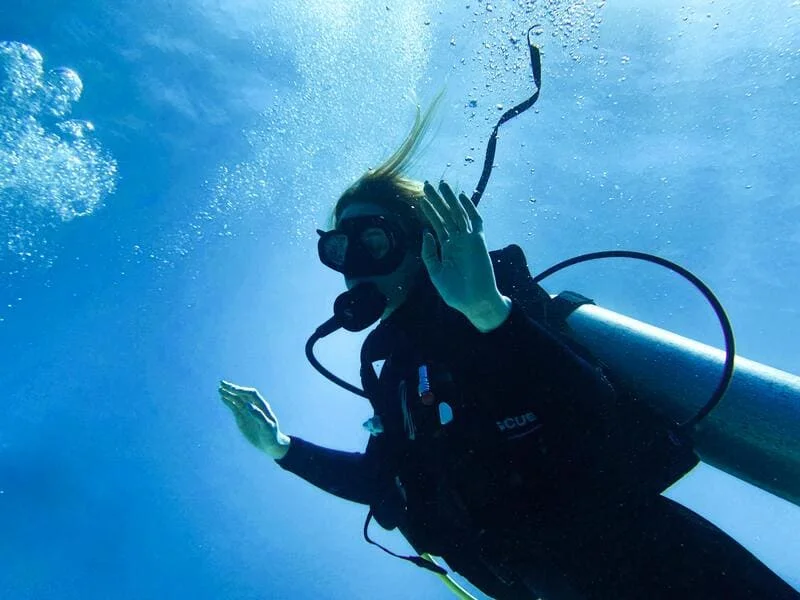
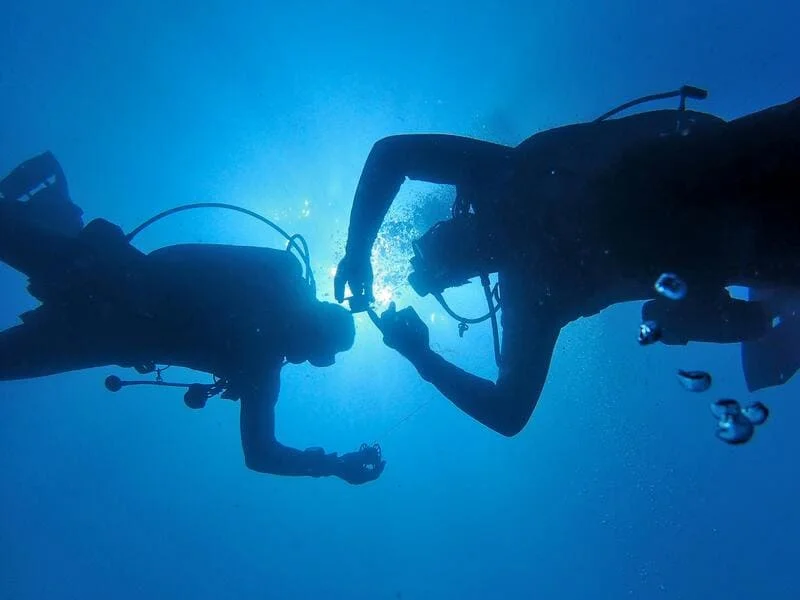
Submerging into the deep blue is, for many, the closest experience to visiting another planet. The moment the water covers your regulator and you descend those first few meters, the outside world vanishes. However, one thing changes drastically: your ability to communicate verbally. Since we cannot speak underwater, the success of a dive and, most importantly, our safety, depends on a precise visual code shared by divers all over the world.
Hand signals in scuba diving are not just curious gestures; they are a critical safety tool that every diver from someone doing their first Discovery Dive in the Mediterranean to a professional exploring wrecks in the Atlanticmust master perfectly. In this article, we will delve into this silent language, analyzing everything from basic gestures to advanced safety signals, so that your next adventure with Paskudive is as smooth as it is safe.
Why are hand signals in scuba diving so important?
Recreational diving is built on the buddy system. We never dive alone. Therefore, the transmission of information must be constant: How much air do you have? Are you okay? Do you want to go up? Without a standardization of these signs, chaos would reign underwater.
The international diving community follows global standards (such as PADI, SSI, or RAID). This allows a diver from London to perfectly understand a dive buddy from Madrid or Tokyo without saying a single word. Hand signals in scuba diving eliminate linguistic barriers and ensure that, in the face of any unforeseen event, the response is immediate and effective.
Basic signals: essential communication for every dive
Before you jump into the water, your instructor or guide will always conduct a “briefing” to review the signs. These are the ones you will use 90% of the time.
1. The “OK” sign (Are you okay? / I’m okay)
This is the most used signal. It is formed by joining the index finger and thumb to create a circle, while the other three fingers remain extended.
- Usage: It is used for both asking and answering. If your buddy gives you the signal, you must respond immediately with the same signal if everything is correct.
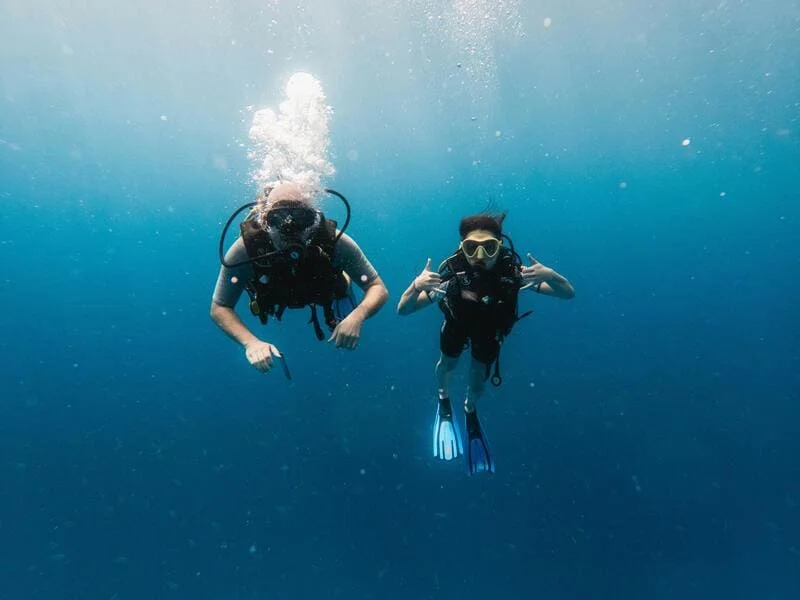
- Common Mistake: Be careful! Never use a “thumbs up” to say you are okay. In the underwater world, a thumb pointing up has a completely different and vital meaning.
2. Problem (something is wrong)
This is done by extending the hand with the palm down and rocking it from side to side.
- Usage: It indicates that something is not going as it should, but it isn’t an extreme emergency yet. Generally, after this signal, the diver points to the source of the problem (an ear, the mask, weights, etc.).
3. Up and down (directionals)
- Going Up: Thumb pointing up with a closed fist. This indicates the end of the dive or the intention to ascend to a shallower depth.
- Going Down: Thumb pointing down with a closed fist. Used at the start of the dive to signal readiness to descend.
4. Level off or maintain depth
An extended hand with the palm facing down, moving horizontally. This is crucial when the guide wants the group to stop at a specific depth for a safety stop or to observe a particular species.
Hand signals in scuba diving for air management
Air management is the factor that determines the duration of your dive. It is vital to know how to communicate exactly how much gas is left in your tank.
How much air do you have?
The buddy or guide will tap two fingers (index and middle) against the open palm of their other hand. To respond, there are two common methods:
- Numerical form: Numbers are indicated with fingers. For example, to say “150 bar” (or PSI equivalents), you might signal a “1” and then a “5” (the zero is usually omitted or represented by a closed fist).
- The “Reserve” Signal: A closed fist near the temple or ear. This indicates that you have reached the 50 bar (reserve) mark and that starting the ascent is mandatory.
I’m low on air!
A closed fist tapping the chest. This signal indicates that the air level is critically low and requires the buddy’s immediate attention to monitor the ascent closely.
Safety and emergency signals: acting with speed
This is where hand signals in scuba diving literally become lifesavers. These signs must be clear, wide, and energetic.
Out of air (total emergency)
Moving an open hand across the throat in a cutting motion from side to side. This is the most serious signal. It means the diver cannot breathe and needs you to provide your alternative air source (the octopus) immediately.
Share air
Bringing the fingertips of one hand together and moving them toward the mouth repeatedly. This indicates the need to use the buddy’s regulator.
Stop!
An open hand with the palm facing forward (like a traffic officer). This is fundamental to prevent a diver from entering a dangerous area or wandering too far from the group.
Communication regarding environment and marine life
Diving isn’t just about technique and safety; a huge part of the fun is sharing discoveries. Depending on where you dive, there are specific gestures for local species:
- Groupers: Placing hands on the sides of the face to simulate large gills.
- Moray Eels: Opening and closing four fingers against the thumb to simulate a snapping mouth.
- Octopus: Placing the back of one hand over the other and wiggling your fingers like tentacles.
- Nudibranch: Two fingers (index and middle) moving like antennae on the back of the other hand.
Tips for better visual communication
- Make Eye Contact: A signal is useless if your buddy isn’t looking. Get their attention by tapping their arm or using an acoustic device (like a shaker).
- Make Signs Clear and Large: Don’t perform gestures right against your chest. Extend your arms so they are visible even if the visibility isn’t perfect.
- Light Your Hands: During night dives, ensure you illuminate your hands with your dive light (without blinding your buddy) while making the signal.
The silence that connects
The sign language under the sea is one of the most beautiful skills we acquire as divers. It allows us to connect with people of any nationality and share the wonder of the underwater world without breaking the respect that the silence of the ocean deserves. Mastering hand signals in scuba diving will give you the confidence needed to explore everything from Mediterranean seagrass meadows to vertical Atlantic walls.
If you are thinking about taking your first steps in this world or want to perfect your technique with experts, there is no better place to start than Paskudive. With professional instructors who prioritize your safety and learning, you will learn not just how to move underwater, but how to speak the language of the sea.
Ready for your next dive? Don’t just let others tell you about it. The true magic happens below the surface. Visit Paskudive.com and book your course or guided excursion today. See you in the blue!